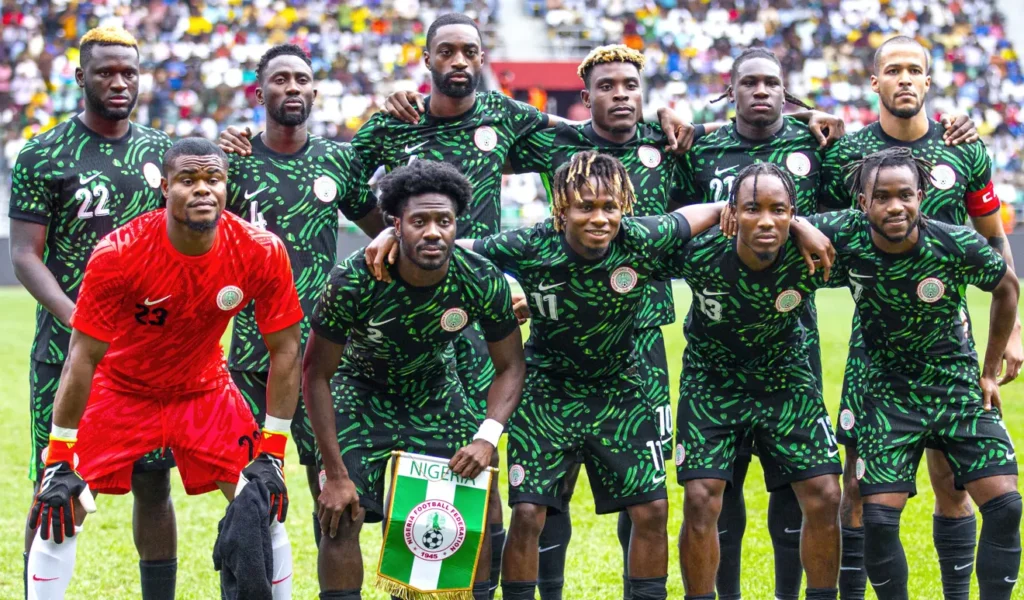
November 16, 2025. Rabat, Morocco. A penalty shootout. Three missed kicks. And the dream was gone.
Nigeria’s World Cup qualifier 2026 campaign ended in the most painful way possible. The Super Eagles — one of Africa’s most talented squads, carrying the hopes of over 200 million people — lost 4-3 on penalties to the Democratic Republic of Congo. The match had finished 1-1 after 120 minutes. When the shootout arrived, history repeated its worst habits.
Nigeria will not be at the 2026 FIFA World Cup in the United States, Canada, and Mexico.
This is the full story. Every phase of the qualifying campaign, what went wrong against DR Congo, the FIFA ruling that made it permanent, and — most importantly — what the Super Eagles and Nigerian football need to do from here.
For all the latest Super Eagles news and analysis, the Super Eagles coverage hub on livescore24.ng is updated regularly.
Nigeria’s Route Through the 2026 World Cup Qualifiers
Nigeria were placed in CAF Group C for the 2026 World Cup qualifying campaign. Their group included South Africa, Rwanda, Benin Republic, and Lesotho. On paper, Nigeria had more than enough quality to top that group.
The reality was messier.
Nigeria started the campaign slowly. Dropped points early. A draw here. A hesitant performance there. By the time the campaign reached its critical stages, Nigeria were scrambling for second place — not cruising through as group leaders.
South Africa had been more consistent. They accumulated points methodically and ultimately confirmed their qualification. Nigeria had to fight for the second qualification spot.
Beating Benin Republic 4-0 at the Godswill Akpabio Stadium in Uyo gave some hope. Victor Osimhen was electric that night, scoring a hat-trick in the first 51 minutes. According to ESPN FC, Osimhen has now scored eight goals across the CAF 2026 qualifying campaign — making him Nigeria’s top scorer in the cycle.
But a draw in South Africa — the 1-1 result at the Free State Stadium in Bloemfontein — ultimately meant Nigeria could not secure automatic qualification. They had to take the playoff route.
You can read more about the Super Eagles’ squad depth and player contributions in the Super Eagles squad 2026 profile.
The CAF Playoff Semifinal: Nigeria vs Gabon
Before DR Congo, Nigeria had to get past Gabon. It was not straightforward. Osimhen had a moment — a miss that shocked even himself — before recovering to score and drag Nigeria through in extra time.
The relief was short-lived. Because up next was DR Congo. And the Leopards had their own story to tell.
Nigeria vs DR Congo: The Playoff Final That Broke Millions of Hearts
The playoff final in Rabat was everything Nigerian football can be at its most excruciating.
Nigeria started well. Frank Onyeka scored in the third minute — a deflected effort that wrong-footed the DR Congo goalkeeper. The viewing centres in Lagos, Abuja, Kano, and Port Harcourt erupted.
Then DR Congo levelled in the 32nd minute. Meschack Elia finished from a flowing team move. The balance shifted. DR Congo controlled large portions of the second half. But Nigeria — thanks largely to outstanding goalkeeping from Stanley Nwabali — stayed in the match.
Crucially, Victor Osimhen went off injured at the start of the second half. That single substitution changed the game’s dynamics. Nigeria lost their most dangerous weapon. DR Congo became braver.
The match went to extra time. Still 1-1. Then penalties.
Calvin Bassey missed first. Moses Simon missed second. Semi Ajayi missed in sudden death. DR Congo captain Chancel Mbemba stepped up and converted the decisive kick. Nigeria were out.
According to Premium Times Nigeria, DR Congo won 4-3 on penalties. The scoreline was close. The margin of pain was not.
Nigeria’s FIFA Complaint and Why It Failed
After the match, the Nigeria Football Federation filed a complaint with FIFA. They alleged that DR Congo had fielded ineligible players during the penalty shootout phase.
The protest generated months of uncertainty. Nigerian fans held out hope. Legal documents were submitted. Statements were issued.
But on March 4, 2026, FIFA circulated an accreditation notice for the intercontinental playoff tournament. DR Congo’s name was on it. Nigeria’s was not. The complaint had been rejected.
As Within Nigeria reported in detail, the FIFA decision was final. DR Congo would compete against Jamaica in the inter-confederation playoffs. Nigeria would stay home.
It was the second consecutive World Cup Nigeria had missed. Qatar 2022. USA/Canada/Mexico 2026. Back-to-back absences for a country that dazzled the world at USA ’94.
What Went Wrong: A Proper Analysis
Nigeria’s failure was not accidental. Several structural problems combined at the worst moment.
Slow start to qualifying. Nigeria did not treat the group stage with the urgency it demanded. Dropping unnecessary points early in Group C forced them into the playoff route. Automatic qualification should have been the baseline objective. It was not treated that way.
Penalty shootout preparation. This is Nigeria’s most persistent failure. The Super Eagles have a poor penalty record under pressure in high-stakes knockout moments. Three misses in a single shootout — from experienced, senior players — speaks to a preparation problem. BBC Sport noted after the match that Nigeria’s penalty record in major knockout stages had become a pattern, not an exception.
Over-reliance on Osimhen. Victor Osimhen is world-class. But when he went off injured in Rabat, Nigeria had no comparable plan B. A squad with the depth Nigeria possesses should not be incapacitated by the loss of one player. Building tactical identity independent of any single individual is a structural requirement. Osimhen’s stats and injury history are tracked in detail on Transfermarkt.
NFF structural dysfunction. Former Super Eagles players like Efe Sodje have been direct in pointing to administration failures. When qualification campaigns are undermined by off-pitch confusion — disputes over payments, camp organisation problems, coaching appointment delays — the players pay the price on the pitch.
For more analysis of the Super Eagles’ structure and what needs to change, the Victor Osimhen Nigeria profile and Super Eagles prediction analysis on livescore24.ng both offer useful context.
The Scale of the Disappointment
Missing one World Cup hurts. Missing two consecutive tournaments is a crisis.
Nigeria qualified for every World Cup from 1994 to 2018. That run — six consecutive appearances — built the Super Eagles’ global reputation. It brought the country moments like Rashidi Yekini’s iconic celebration in 1994. It gave Nigerian fans the Jay-Jay Okocha era, the Kanu Nwankwo generation, the excitement of Nigeria’s Round of 16 appearances.
Missing Qatar 2022 was painful. But it could be framed as a blip.
Missing 2026 after having a squad with Osimhen, Lookman, Ndidi, Iwobi, Bassey, Simon, and Chukwueze — players performing at the highest levels in European football — is something else. It is a failure of organisation and structure, not talent.
According to CAF Online, Nigeria remain one of Africa’s most decorated football nations. Three AFCON titles. A World Cup quarterfinal appearance in 1994. The talent pipeline is not the problem. The structures around it are.
What Comes Next for the Super Eagles
Nigeria’s next competitive objective will be the 2027 AFCON qualifying campaign. The continent’s biennial championship is the next platform for the Super Eagles to restore national pride.
Eric Chelle’s position as coach came under enormous scrutiny after the DR Congo defeat — his comment blaming “voodoo” for the penalty shootout loss did his credibility no favours with Nigerian football fans or the wider football community.
The NFF will need to make several hard decisions.
Coaching direction. Does the Super Eagles coaching setup require a reset? The 2027 AFCON qualifiers are the immediate test. Nigerian football fans will demand an improvement in both performance and organisation.
Youth development. Nigeria’s long-term health depends on building a pipeline below the senior team. The NPFL — despite its challenges — is the foundation of that pipeline. A stronger domestic league means stronger player development. The NPFL hub on livescore24.ng tracks that domestic story closely.
Penalty preparation. This sounds simple. It is not simple in practice. But it must be addressed. Penalty preparation has to become a core part of every Super Eagles training camp before knockout competitions.
Building on Osimhen. Osimhen will be 28 when the 2030 World Cup qualifying begins. That campaign starts in 2028. He should be at the peak of his powers. Building a squad capable of winning group-stage matches without needing to rely on him in a shootout is the real task ahead.
Nigeria in the 2030 World Cup Qualifying Cycle: Early Expectations
The 2030 World Cup will be co-hosted by Morocco, Portugal, and Spain — with additional centenary matches in Argentina, Uruguay, and Paraguay. CAF’s qualifying allocation is expected to remain at nine or ten automatic spots.
Nigeria should be targeting automatic qualification — not playoff survival. That requires a cultural shift inside the NFF and the Super Eagles technical setup.
The current generation of players is good enough. Lookman won the UEFA Europa League with Atalanta. Osimhen is consistently among the best strikers in Serie A. Ndidi, Iwobi, Simon, Bassey — these are established European professionals. The talent is there.
What Nigerian football needs to build is the structure, discipline, and tactical consistency to match that talent on the biggest stages.
For anyone placing bets on the Super Eagles’ future games — AFCON qualifiers starting in 2026, friendlies, and tournaments — the Super Eagles predictions section on livescore24.ng will have full match previews, odds analysis, and betting tips as fixtures are confirmed.
You can also get full global context on the Super Eagles in FIFA’s world rankings and detailed squad statistics on FBref.
What Nigerian Bettors Should Know About Super Eagles Betting Going Forward
Despite missing the World Cup, Super Eagles fixtures will continue. AFCON 2027 qualifying, friendlies, and — looking ahead — the 2030 World Cup qualifying campaign will all generate major betting interest in Nigeria.
Here is what the data tells us about betting on Super Eagles matches.
Super Eagles home matches are historically strong betting value on the Asian Handicap. When Nigeria plays at the Godswill Akpabio Stadium or the National Stadium in Abuja, they typically dominate weaker opposition. Laying the handicap against CAF lower-ranked opponents offers consistent value.
Super Eagles penalty markets are a trap. Given the shootout history, never build a betting strategy that depends on Nigeria converting penalties. The pattern is clear. Use penalty-related markets cautiously.
Osimhen’s anytime scorer odds are often underpriced. When fit and playing, Osimhen scores at an elite level. His anytime scorer odds on Nigerian platforms — typically between 1.65 and 2.10 depending on the opposition — can represent value for Super Eagles fixtures.
For betting tips when the Super Eagles next play, check the Super Eagles prediction page for full analysis. Use the betting calculator before placing any stakes, and always read up on how decimal odds work if you are new to reading the odds platforms.
For platform-specific guidance on where to place your bets, Sportybet Nigeria, Bet9ja, and BetKing all carry Super Eagles markets when fixtures are live.
Remembering What Nigeria Football Can Be
For all the pain of the 2026 World Cup miss, Nigerian football is not in permanent decline. It is in a temporary structural crisis that talented, organised leadership can fix.
The Super Eagles have produced moments that stay with football fans forever. Kanu’s hat-trick against Spain at the Atlanta Olympics. Jay-Jay Okocha terrorising defenders at every tournament he entered. Sunday Oliseh’s thunderbolt goal against Spain in France 1998. Mikel and Emenike helping Nigeria win AFCON 2013 in their own country.
Those moments were built on talent AND organisation working together. Nigeria has the talent. The organisation needs to catch up.
The next chapter of Super Eagles football starts now. And livescore24.ng will be there for every match, every preview, every prediction, and every live score along the way. Follow the Super Eagles hub, keep an eye on the latest news section, and stay with the predictions hub for all the analysis you need.
Nigeria will bounce back. The Super Eagles always do.
Responsible Gambling Notice
This article includes references to betting markets for Super Eagles fixtures. Betting involves financial risk. Never stake money you cannot afford to lose.
Always set a budget before betting. Never chase losses. If betting is affecting your life negatively, seek support at BeGambleAware or the National Council on Problem Gambling. The responsible gambling page on livescore24.ng has further guidance tailored for Nigerian bettors.
For live Super Eagles news, predictions, and scores — livescore24.ng is your home.
Pingback: CAF World Cup 2026 Qualifiers: Stats, Groups, & Predictions